A lightweight agent runtime for teams that run their own models. Composable and local, always.
toolama hands a job to a model already running on your machine, gives it the tools that job needs, and writes down everything it did. One Python file, no dependencies, and no account or server of anybody else's in the middle of a run. It is for people and small businesses who want a fleet of small automations on hardware they already own: the weekly books, the repository nobody has read in a month, the thing you keep meaning to learn.
A co-worker is a job written down as a folder: the instructions in plain prose, the connectors it may use, what it is allowed to change, sample data you can run with no network, and a checker that reads the real output and decides whether it holds together. The model saying "done" never counts.
money
The bookkeeper reconciles a business bank account against the books. personal-books files what the bank link dropped into a household plan and covers what the month went over by.
learning
The tutor teaches one thing on purpose: six to ten lessons, one a session, and it remembers where you got to.
business
The reviewer reads a GitHub repository and opens an issue for each thing worth an afternoon. Three at most, never one already filed, never without asking.
workplace
The desk answers in Slack and writes down what you tell it. The researcher answers one question from the web with the receipt. The chapter co-worker drafts a chapter a day. The builder writes the next co-worker for you.
creative
Empty today. Video, stills and songs are planned, and each one waits on a connector to the generator behind it.
travel
Empty today. Planning a trip is easy; booking one means a connector for whatever you book through, and most booking sites have no MCP server at all.
shopping
Empty today. A restocker needs somewhere to buy through, and the shops most people use are built for selling rather than for buying.
02
Five minutes
ollama pull qwen3.8:27b
git clone https://github.com/ghosthat-studio/toolama && cd toolama
./install.sh

toolama run coworkers/researcher/sample \
  --input message="what is the Model Context Protocol and who maintains it"

toolama connect webread
toolama connect knowledge
toolama run researcher --input message="how does Ollama pick which GPU to use?"

toolama connect slack --bot
toolama listen slack
The sample starts its own servers against four saved pages, so it opens no socket and needs no token. Neither of the two connectors after it asks for one either. The last two lines put every co-worker on the machine behind one bot: @toolama help is the list. Python 3.9 or newer and Ollama. macOS, Linux, and WSL. If your shell cannot find toolama, add ~/.local/bin to your PATH; install.sh prints the line to add.
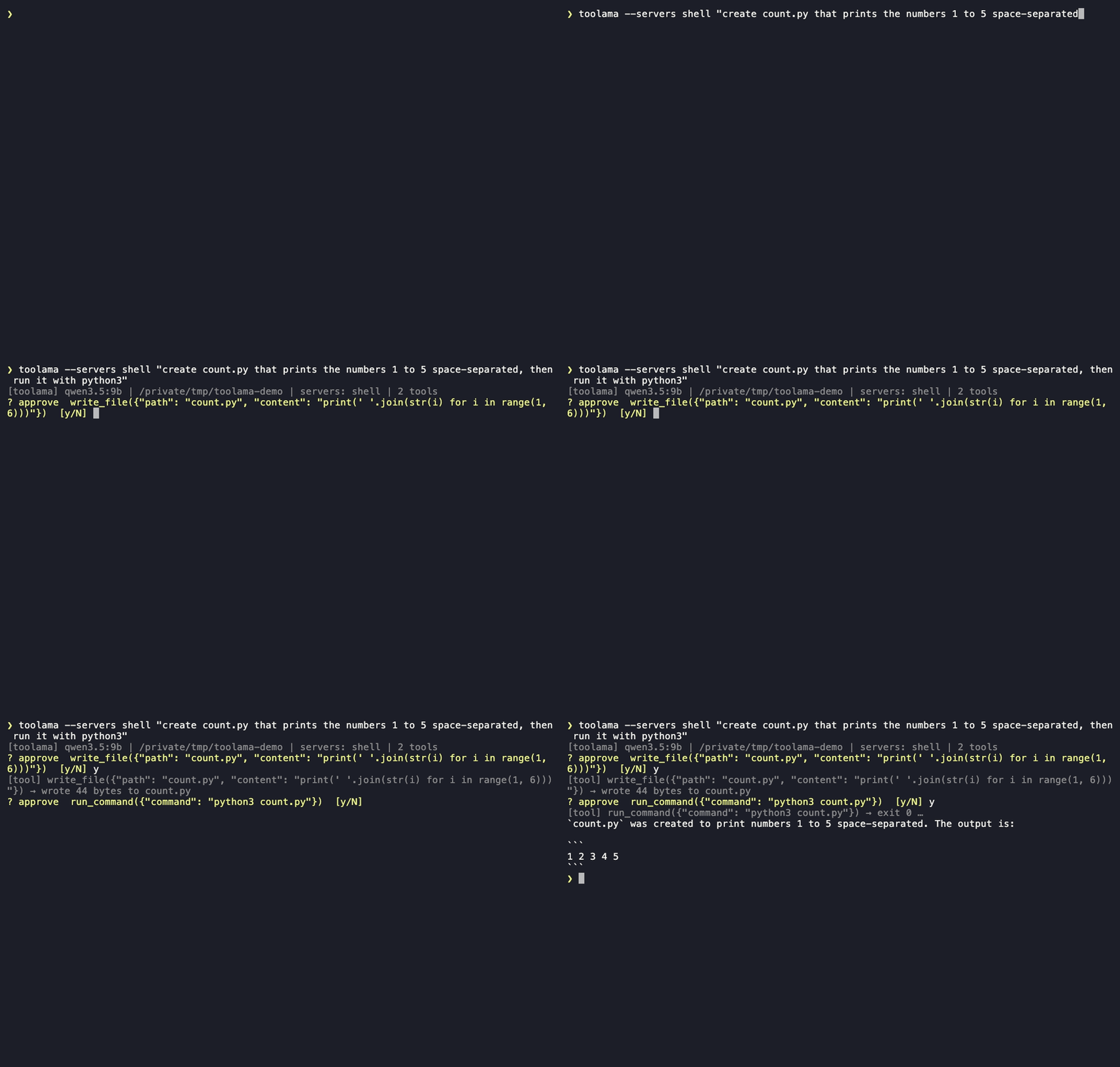
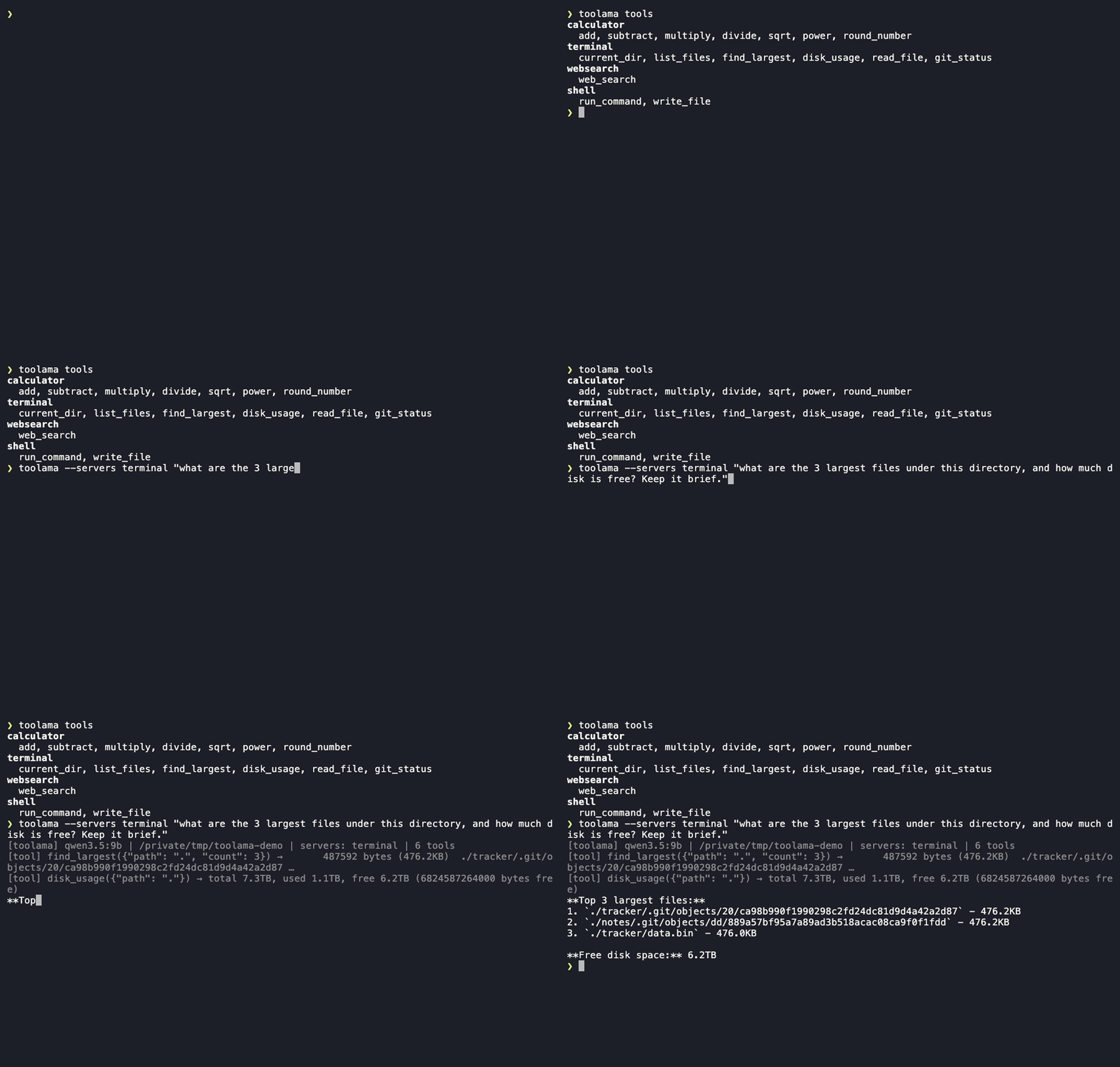
One prompt, two tools, routed to the servers that own them.
03
What the real runs cost
Measured on a MacBook Pro with Apple silicon, on qwen3.8:27b unless it says otherwise. The desk and the tutor run on a 9B, which is a laptop. The rest want the 27B: they read a lot before they say anything, and a smaller model loses the thread.
11 s
The desk answering a direct message in Slack, from the message landing to the reply going up.
59 s
The researcher over four saved pages, with a cited sentence under every claim it made.
~2 min
The bookkeeper reconciling a bank account against the books, started from a Slack message.
15 rows
Real bank rows filed into categories by personal-books, off one "yes to all" in the thread.
~5 min
The builder writing a co-worker folder that runs, from a sentence saying what it should do.
~27 min
The reviewer to its first issue on a real repository. The 160 KB main file it had to read is most of the reason.
1,464
Automated tests. Six connectors are live; HubSpot is built and nobody has signed in to it yet.
The tutor's lessons are good and the shape of its replies still wanders. That is the honest state of it today.
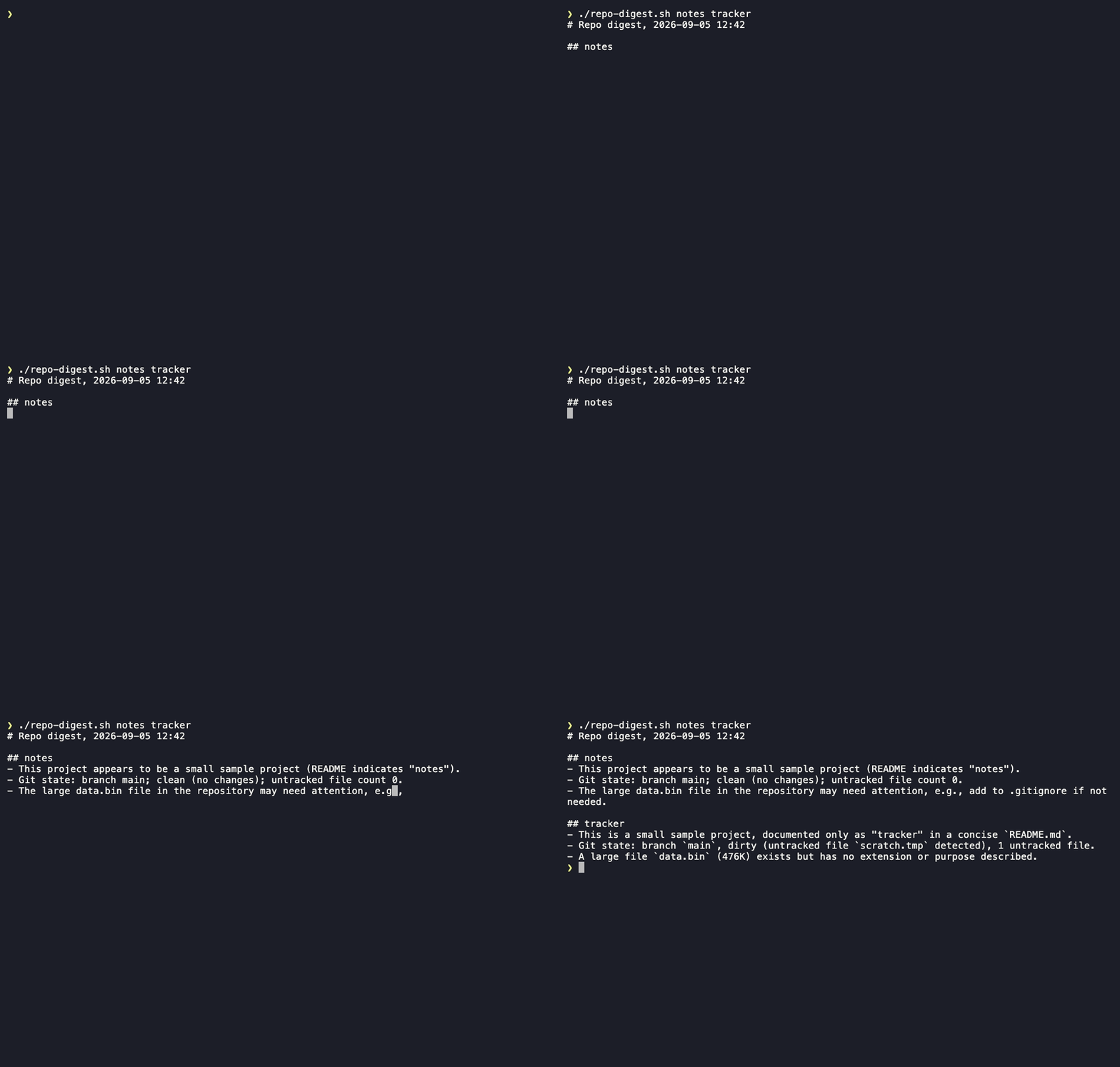
repo-digest.sh, one of four small shell examples in the repo.
04
Approvals, records, and no clock on the model
Anything that changes something asks first, at a terminal or in a Slack thread, and there is no flag that approves everything. A co-worker writes down which connectors it may use and which of their tools are writes before it runs at all. Every run leaves a record: what was asked, which model, every tool call with its arguments and its answer. Turns are limited, because turns count how much work a job is allowed to be, and a tool call has a deadline, because that guards a call out to somebody else's API. How long the model spends thinking is its own business. The shell connector is not a sandbox, and an approved command runs as you.
05
The honest comparison, and the book
Hermes and OpenClaw are real, they are composable, and they run local models too. They do a great deal more than this does, and the price of that is size: more to install, more to configure, and more to learn before the first job runs. toolama is the small end of the same idea, and the pitch is that it is good enough for these jobs and it is yours.
There is a book being written alongside it, on running a personal automation fleet on models you own. Nine chapters, one for each bucket after the first two, every chapter carrying one line of thesis that the chapter co-worker goes out and tests each morning against the sources. toolama is its companion, not its appendix.
Ghost Hat Studio installs it, connects it, keeps it working, and supports it.