The Bright Factory That Runs Ghost Hat Studio
If you haven’t run across the term, dark factories are lights-out manufacturing plants, an idea coined in Japan in the 1980s when FANUC set robots to building other robots around the clock. No people on the floor, so no reason to pay for light. Lately the idea has moved into software, where a few teams now run whole pipelines that write, test, and ship with no person in the loop. They’re fascinating experiments, and for a civilization with ambitions to settle distant planets they aren’t really optional. But we’re on Earth, and we like working with people. Our AI team is built to make human work more fun and less tedious, not to switch the humans off.
A morning at the studio
Most mornings the first thing I do is open the dashboard, and there's already a bench of ideas waiting for me, things worth writing about, pulled from the day's news and the corners of the open-source world we watch. Each one has been looked over before it gets to me. What happens next depends on the day.
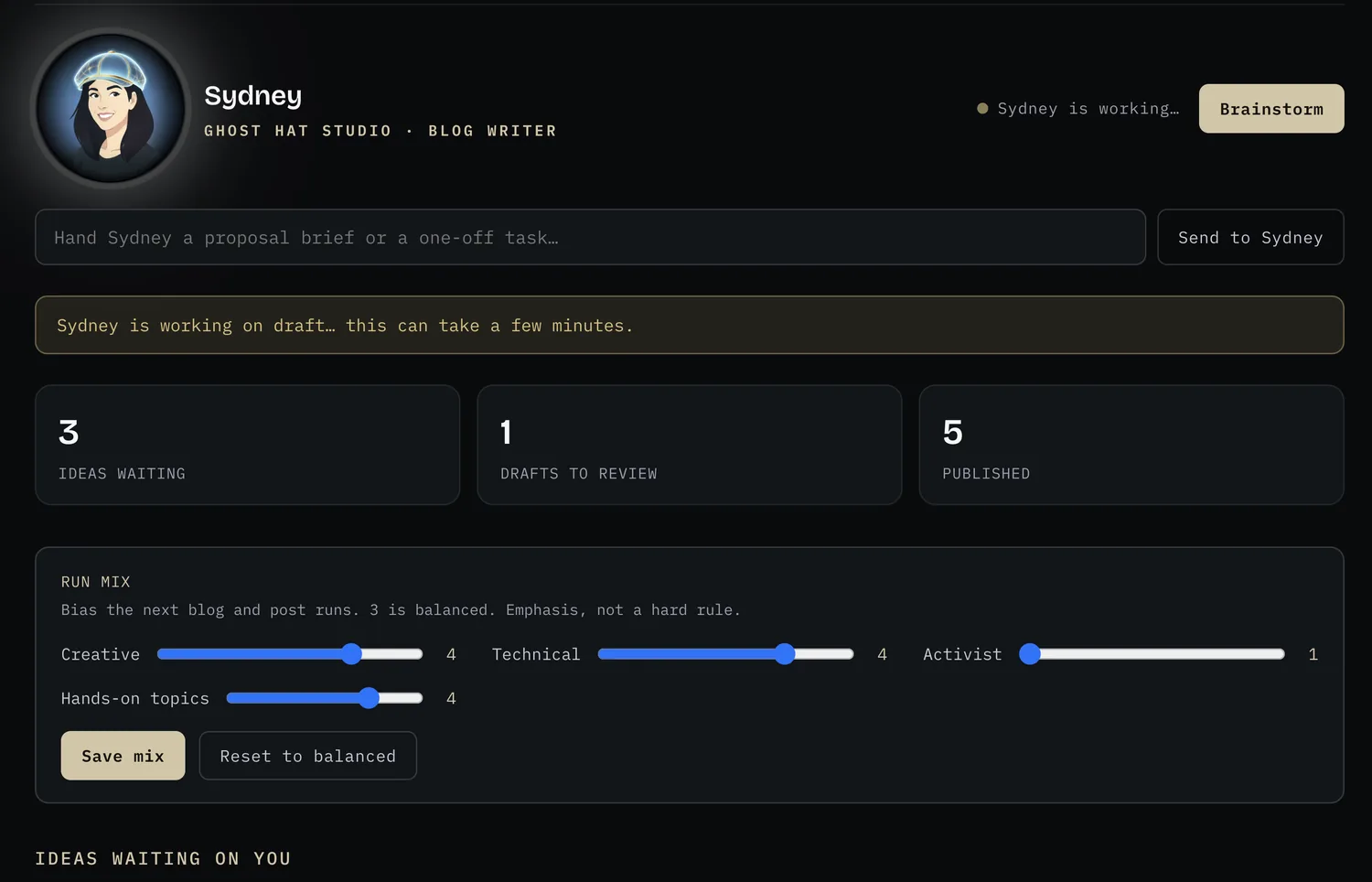
Some mornings I'm slammed, so I point Sydney at a topic and let her write the whole thing. Sometimes I heavily edit it to my own voice or leave a note: Lose the second paragraph, sharpen the ending. She takes another pass at just that. Other times I rewrite it myself because I can already hear how it should sound.
And sometimes the idea starts with me. I hand her a rough brief, she researches it, comes back with an angle and an outline, and once I like where it's headed it joins the same machinery as everything else.
The dashboard has sliders for the writing itself, how technical it gets, how opinionated, how much it leans on the news versus the hands-on stuff.
Most days, honestly, I don't do much. The agents are good. That Ford piece we ran last week, about the 350 veteran engineers the company rehired after automating them out, went up almost exactly as Sydney wrote it. I changed a line or two and sent it.
Six agents running locally on a Linux box in my office
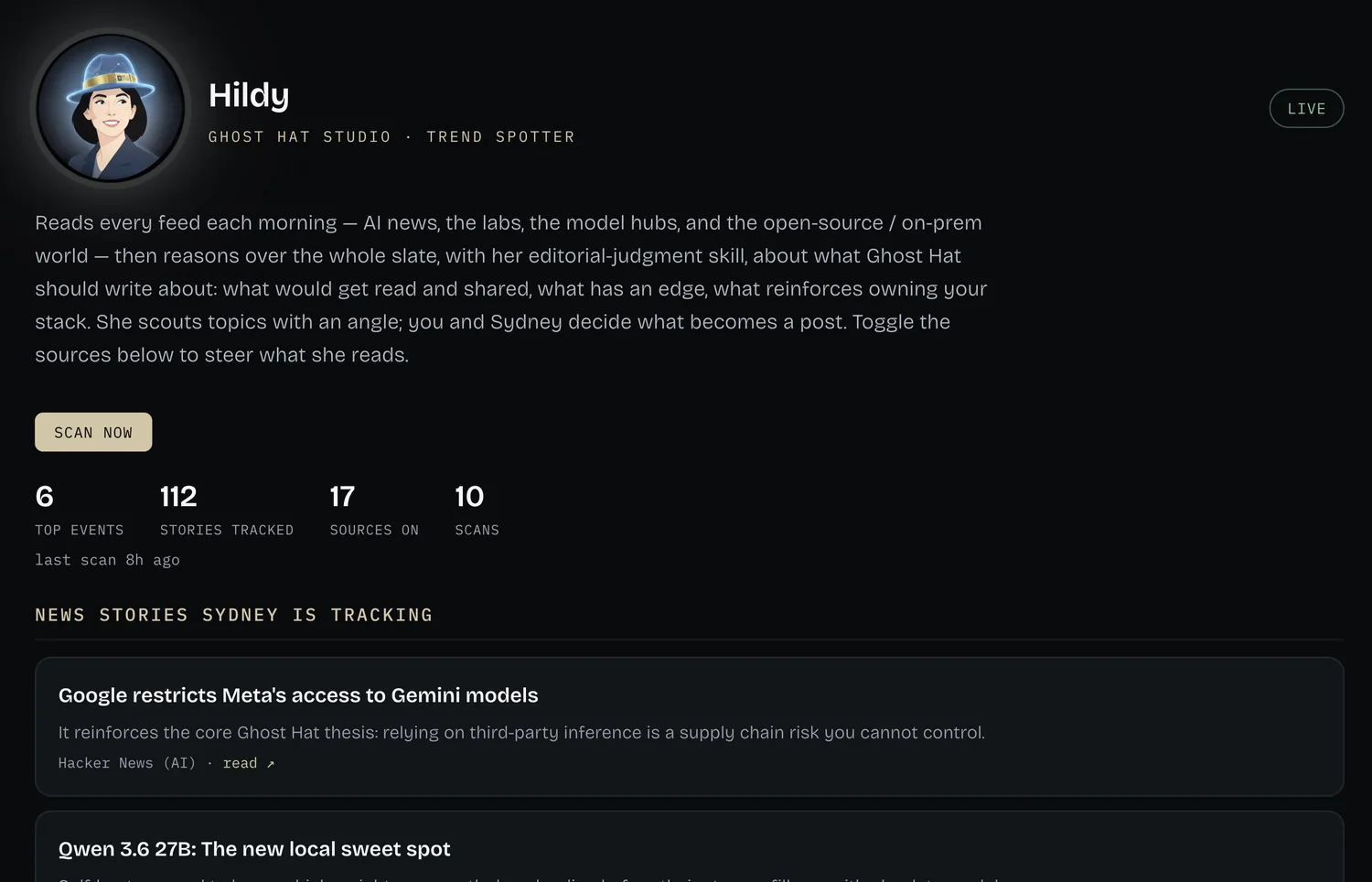
Hildy is our trend spotter. She reads the feeds every morning and hands off a short list that Sydney can generate draft ideas from, and the Ford story caught her attention because it's closely aligned with our values.
Sydney drafted it on a model running right here in the building. She writes to our house rules, then she checks herself. She runs the claims back against sources, and anything she can't stand behind she flags for me. The numbers in the Ford piece, the 350 engineers, the warranty savings, had all been checked before I ever saw them.
I read it, made my edits, and told it when to go out. From there it's hands-off. An image model running on hardware we own generates the art, no stock photos and nothing pulled off the web. On its scheduled day the machine builds the page and publishes it while I'm doing something else. Then Iris writes the LinkedIn version, one sharp line and a link rather than a recap, and leaves it for me to look at.
Flexible endpoints
The dashboard is where I spend most of my time. It shows every agent on one page: Hildy’s bench, Sydney’s drafts, what’s queued, what’s shipped, and the run numbers. I approve drafts there and set the dials that shape the writing.
For a one-off job I use the command line. Each agent is a command. Marlowe is our lead scout; to send him after new prospects:
$ marlowe hunt "robotics startups hiring in the PNW"
6 prospects added to the bench
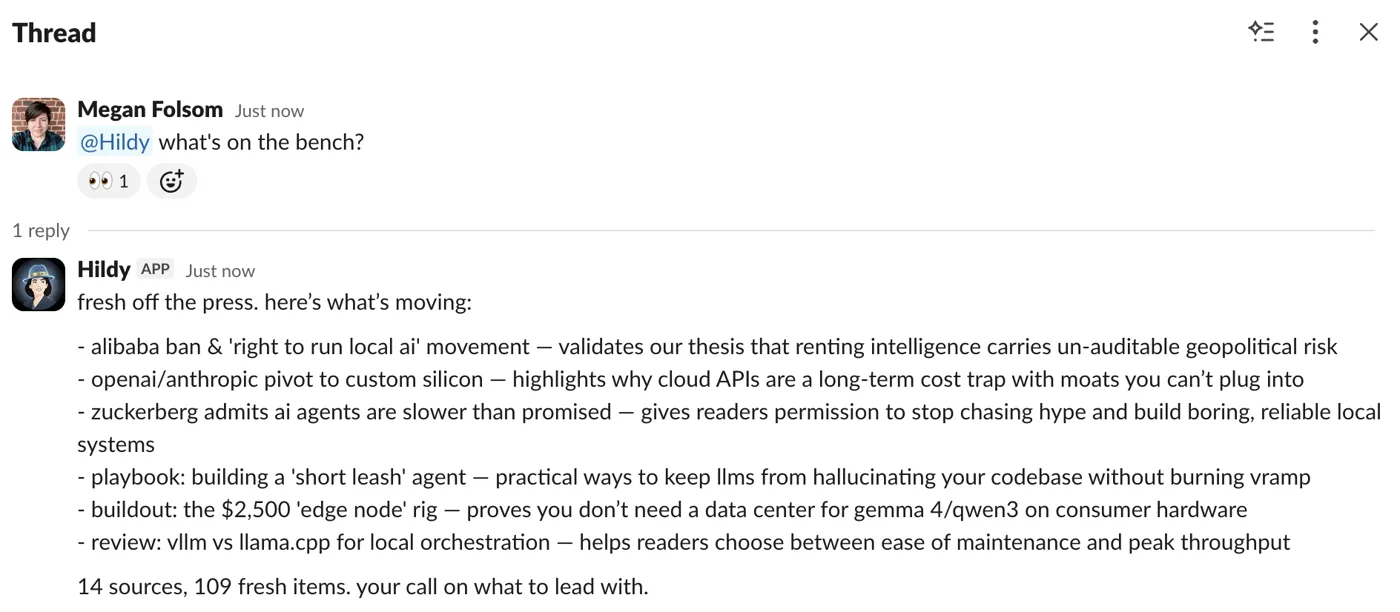
Every agent is also a Slack bot, through a tagging system we built ourselves (a full write-up is coming soon, subscribe to catch it). Tagging one by its handle gives me the same full control I get from the dashboard or the command line, not just answers: I can put Hildy on a fresh scan, send Marlowe after leads, or pull up what Sydney is drafting, right from a channel or a thread. They work from the same live state as everything else.
The factory lights are on
The bright factory means I can stay accountable for everything that goes up on my ecosystem without getting snowed under. I can automate as much or as little as I want and see all of the production lines running on the factory floor.
Owning it is the reason all of this holds together. It runs on our hardware, so there's no token meter running overnight, no draft of ours sitting on someone else's servers, and no company that can change the rules next week and break my pipelines.
This crew is worth a lot to a bootstrapping founder, and it’s also why I’m in no hurry to run dark. The day Ghost Hat is big enough, I plan to hire people to work alongside the agents. Someone should be around to keep them company.
More from the blog →